Understanding Centimeter to Micrometer Conversions
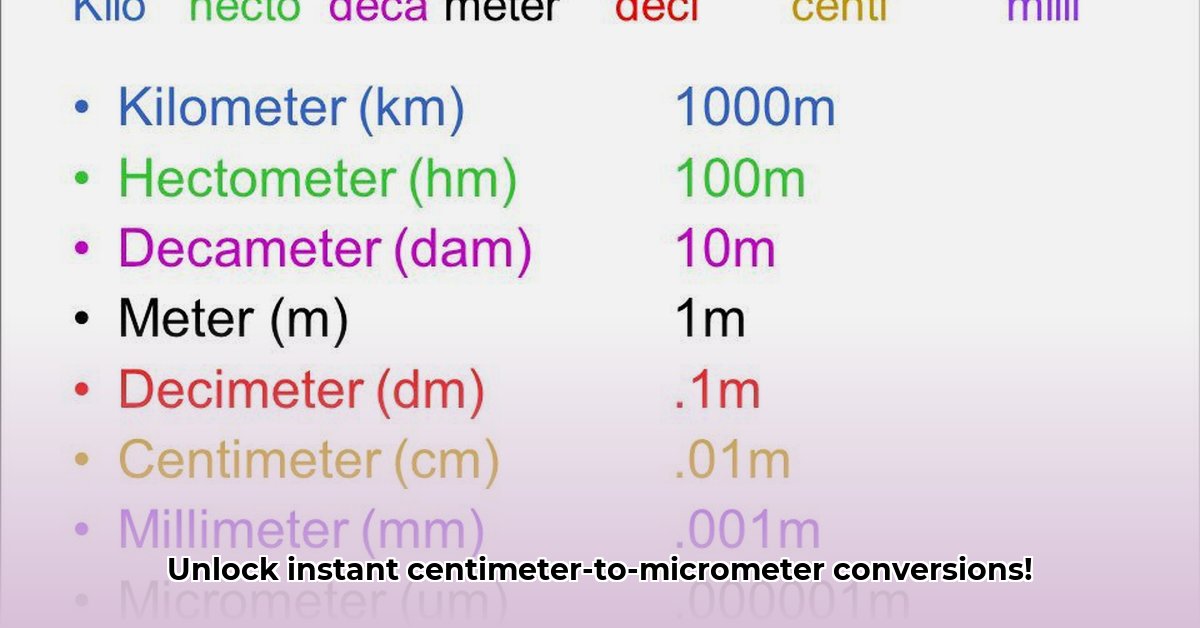
Ever needed to convert centimeters (cm) to micrometers (µm)? This comprehensive guide provides a step-by-step process, highlighting potential pitfalls and offering practical applications. Whether you're a student, researcher, or engineer, mastering this conversion is crucial for accurate measurements in various fields. A micrometer (µm), also known as a micron, is one millionth of a meter, significantly smaller than a centimeter (cm), which is one hundredth of a meter. For more online converters, check out this useful resource.
The Basic Conversion: A Simple Three-Step Process
The fundamental conversion factor is 1 cm = 10,000 µm. This means you simply multiply the number of centimeters by 10,000 to obtain the equivalent in micrometers.
Step 1: Identify the value in centimeters. Let's say you have 2.7 cm.
Step 2: Multiply by 10,000. 2.7 cm * 10,000 µm/cm = 27,000 µm.
Step 3: State your answer with units. Therefore, 2.7 cm is equal to 27,000 µm.
Did you know that a human hair is typically between 50 and 100 µm thick? This illustrates the significant scale difference between these two units.
Let's try another example: Convert 0.025 cm to micrometers. Following the steps above, we get 250 µm. Simple, right?
Potential Sources of Error and Mitigation Strategies
While the conversion itself is straightforward, inaccuracies can arise from several sources:
Instrument Precision: The accuracy of your measuring instrument directly impacts the precision of your conversion. A ruler accurate to 0.1 cm will yield less precise results than a caliper accurate to 0.01 cm. Using high-precision instruments is critical for accurate measurements.
Significant Figures: The number of significant digits in your initial measurement limits the accuracy of the final result. For example, if your measurement is 2.5 cm (two significant figures), your converted value should also reflect this limitation.
Environmental Factors: Temperature and humidity can affect the length of materials, particularly for precise measurements. Controlling for these environmental variables helps ensure accuracy.
To minimize error, always use accurately calibrated instruments, be mindful of significant figures, and control the environment as much as possible. It also helps to take multiple measurements and average them to reduce random errors.
Advanced Applications: Microscopy, Nanotechnology, and Beyond
Beyond simple conversions, understanding centimeter-to-micrometer conversions is crucial in fields requiring high precision.
Microscopy: In microscopy, accurate conversions are vital for interpreting image scales and calculating object sizes. A single micrometer can mean the difference between seeing a detail or missing it completely.
Nanotechnology: Nanotechnology deals with structures at the nanometer scale (1 nm = 0.001 µm). Accurate centimeter-to-micrometer conversion is a foundational step in scaling up designs from nanometer-level simulations to macroscopic prototypes.
Materials Science: The study of materials often requires precise measurements of dimensions affecting material properties. Accurate conversions are critical for replicating experimental results.
Practice Problems to Solidify Your Understanding
Here are some problems to test your skills. Remember to pay attention to significant figures:
- Convert 5.8 cm to micrometers.
- Convert 0.002 cm to micrometers.
- If a component measures 12000 µm, what is its length in centimeters?
(Answers: 58,000 µm; 20 µm; 1.2 cm)
Conclusion: Mastering Micrometer-Scale Measurements
Accurate conversion between centimeters and micrometers is a fundamental skill in science and engineering. By understanding the basic conversion, being aware of potential error sources, and utilizing proper measurement techniques, you can confidently work with measurements at both the centimeter and micrometer levels and achieve precise results. Remember, careful measurement and calculation are key to success. Always double-check your work and strive for the highest level of precision possible in your experiments and applications.